
Browser Fingerprinting Is a Consistency Audit, Not a Checklist
Canvas, WebGL, audio, clean realms, WebAssembly, storage, and automation traces become meaningful when they are evaluated as one device story.
Think of a machine under questioning
A browser fingerprint is often reduced to a table of properties: user agent, platform, screen, fonts, plugins, canvas, and an automation flag. That table encourages a misleading strategy—change each visible value until the report looks ordinary.
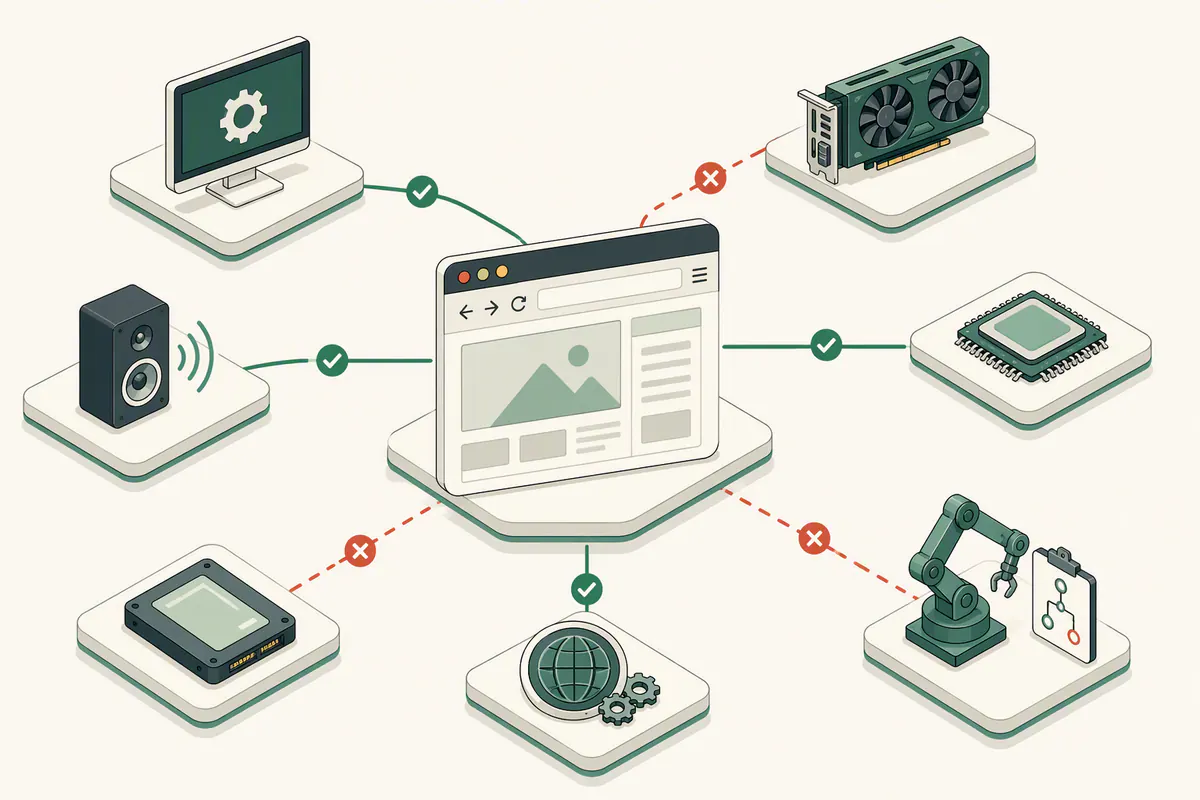
A stronger detector does something different. It asks related questions through unrelated subsystems and looks for answers that could have come from the same device. The operating system claim, graphics behavior, audio output, input capabilities, browser APIs, and low-level timing all become witnesses. The most useful evidence is often disagreement between them.
Surface flags are weak evidence
The WebDriver standard defines an automation-related state exposed through `navigator.webdriver`, but a production risk decision should never depend on that property alone. Browser versions, test environments, enterprise tooling, privacy products, and instrumentation can all change what a single API reveals.
The same warning applies in both directions. A positive automation flag is not proof of abuse, and a negative flag is not proof of a person. The useful question is whether the surrounding runtime behaves like the browser, operating system, and device it claims to be.
Canvas and WebGL describe a rendering system
Canvas output depends on fonts, antialiasing, graphics drivers, pixel density, operating-system text rendering, and the available GPU path. WebGL exposes another view through renderer information, extensions, precision, limits, and actual rendering behavior.
Changing a renderer string does not change the pixels or performance characteristics produced underneath it. A believable observation is relational: the renderer, extension set, canvas output, screen configuration, and timing should all fit the same class of machine. Software rendering is legitimate, but it should not simultaneously claim consequences that require a different graphics stack.
Audio, math, and WebAssembly measure consequences
Audio processing can expose small implementation differences in floating-point behavior and platform stacks without accessing a microphone. Mathematical edge cases, CSS calculations, and WebAssembly workloads can likewise reveal properties of the runtime beneath JavaScript-visible labels.
These techniques matter because they measure consequences rather than declarations. A platform string is cheap to change. Reproducing the combined output of the operating system, CPU architecture, graphics driver, media stack, and browser build is much harder. Timing is noisy and should be treated statistically, especially on virtualized or busy devices, but it adds another consistency axis when used carefully.
Patches can become evidence themselves
Many automation-hiding techniques replace getters or wrap native APIs. That can repair one visible result while altering property descriptors, prototypes, function serialization, error behavior, or object identity. The patch solves the first question and creates several new ones.
A page can also create a fresh iframe and compare APIs from its separate realm with the modified top-level window. This does not make every difference malicious—extensions, accessibility software, and security agents can modify pages too—but it demonstrates why isolated JavaScript shims are fragile. The detector is evaluating provenance as much as value.
State can link visits even when cookies change
Fingerprinting and bot detection solve different problems. Fingerprinting attempts to recognize a returning browser or device; bot detection estimates whether a request or session represents unwanted automation. A system may use both, but the outputs should not be confused.
Storage behavior, process-level state, cache characteristics, and stable runtime properties can correlate visits beyond an individual cookie. This creates privacy risk for ordinary users, which is why the W3C treats fingerprinting as a capability that specifications should minimize. Defenders should collect only signals justified by a concrete abuse case, retain them for a bounded period, and govern access like other sensitive telemetry.
Model a graph of relationships, not a list of checks
A useful implementation stores observations in families and evaluates their relationships. Platform should agree with input capability and media support. Browser version should agree with client hints and feature availability. Graphics declarations should agree with rendered output. Automation state should agree with runtime behavior and navigation history.
This graph also reduces false certainty. A rare canvas value is not automatically bad. A clean extension profile is not automatically automated. A virtual GPU is not automatically abusive. Confidence should rise only when multiple independent relationships fail in a way that matters for the protected route.
- Record which signal family contributed to a decision, not just the final score.
- Separate stable device correlation from short-lived session-risk evidence.
- Calibrate by route and population; corporate, privacy-focused, and accessibility users need room for legitimate variation.
- Use progressive responses and measure conversion, support load, and false-positive rate alongside blocks.
The practical conclusion is consistency
Modern browser fingerprinting is not a hunt for one perfect hash. It is an audit of whether many observable effects could naturally coexist. Real devices contain quirks, but those quirks grew from one physical and software environment. Artificial profiles often look cleaner while containing seams between independently chosen parts.
For legitimate automation, the lesson is not to build a more elaborate disguise. Use supported APIs and verified access paths where available, identify the client honestly, keep rates bounded, and use a real browser only when rendering is part of the authorized task. A coherent operational identity and clear provenance are more durable than an endless patch list.
Sources and further reading
Try the smallest path that fits your target
Start with the public Fetch guide, then add browser rendering, crawling, or extraction when the workflow needs it.