
Bot Detection Judges the Whole Session, Not a Single Fingerprint
Modern defenses correlate network identity, navigation, interaction, resource timing, and session history instead of trusting one browser fingerprint.
One request is not a person
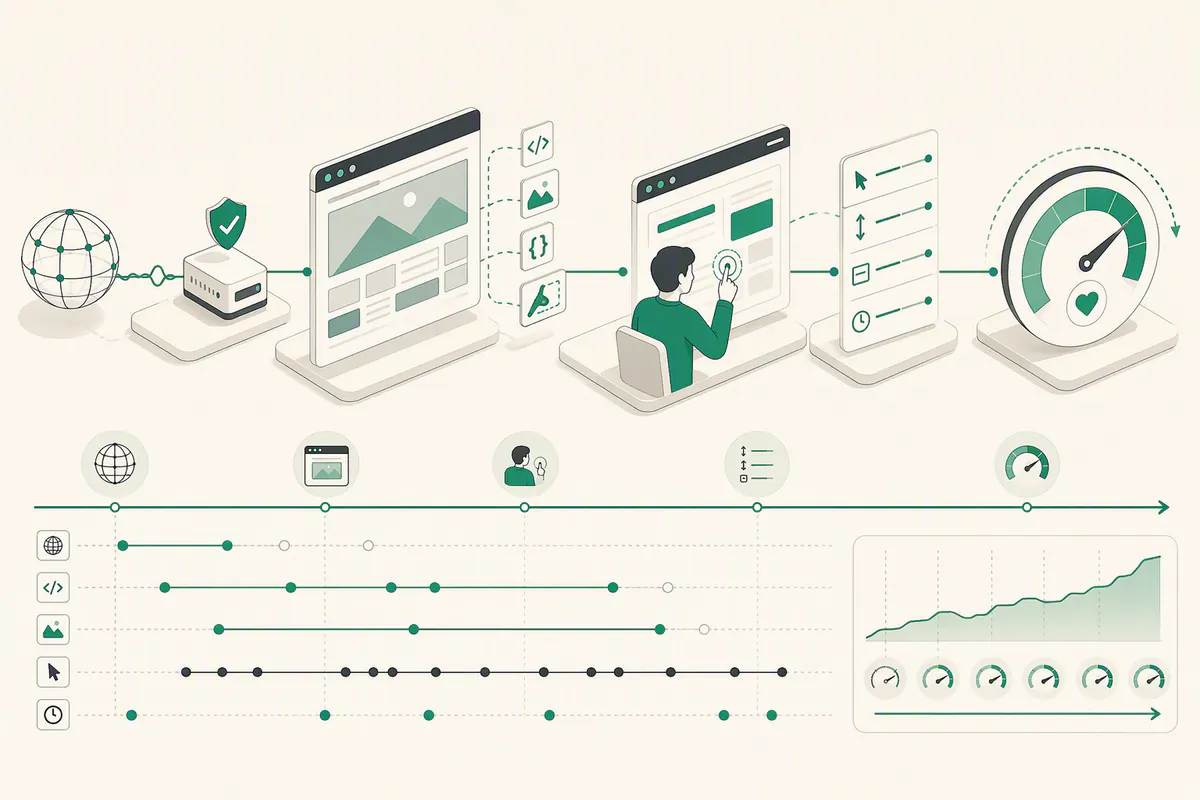
Bot detection is still commonly explained as a fingerprint check: inspect the user agent, canvas output, WebGL renderer, automation flags, and perhaps a few headers. Those signals matter, but they describe only a moment. A production defense has a much richer object to evaluate: the visitor's entire session.
The important question is not whether one request can resemble Chrome. It is whether the network, browser, navigation path, resource loading, interaction, and history keep describing the same plausible visitor. A polished browser surface cannot rescue a session whose surrounding evidence contradicts it.
Identity begins before the page
Before client-side code runs, the service already knows where the connection arrived from and how that source has behaved before. IP reputation, autonomous system, broad geography, connection history, and request cadence establish an initial level of confidence. This is not a verdict; corporate gateways, VPNs, mobile networks, and privacy tools create legitimate exceptions. It is a prior that later evidence can strengthen or weaken.
Geographic signals become useful when treated as a relationship rather than a lookup. An exit country, locale, time zone, DNS behavior, and exposed network properties do not need to be perfect, but they should form a life-like explanation. Real users are messy in understandable ways. Synthetic sessions often combine values selected independently, producing a device that is plausible one field at a time but implausible as a whole.
Some controls test intent, not appearance
A hidden link or form field can reveal a collector that walks every DOM node without considering what a person can actually see or use. These traps are simple, but they ask a powerful question: is the client following the product's visible interaction model, or mechanically enumerating its structure?
A defender does not have to block immediately after a trap fires. The event can lower trust, reduce result detail, trigger review, or attach a traceable marker. That last option matters because a silent stream of incorrect or watermarked data can expose downstream redistribution more effectively than a loud 403. Any such response needs careful legal, ethical, and product review; poisoning data can harm innocent integrations if targeting is weak.
Human behavior has structure, not just noise
Random delay is not the same as human activity. People accelerate and correct pointer motion, pause at meaningful content, change scroll distance, focus an input before typing, switch attention, and occasionally reverse a decision. Those events are related to the interface in front of them.
A useful behavioral model therefore correlates signals instead of grading an isolated gesture. Was the page visible during the claimed reading interval? Was the field focused while text arrived? Did the navigation path make sense for the task? Does the next request follow the content the user could have discovered? Perfect regularity is suspicious, but meaningless randomness can be just as unnatural.
The server sees a timeline even without JavaScript
Server-side timing is an underused source of evidence. A real browser discovers HTML, styles, scripts, images, and fonts through a scheduler with priorities, connection limits, caches, and conditional requests. A manual request list often produces a different dependency order and reuse pattern.
The same is true at the application level. A detail request that arrives before any plausible discovery path, a supposedly warm session that repeatedly behaves like a cold start, or pagination that advances faster than the content could be reviewed can all reduce trust. None proves automation alone. Together they describe how the client behaves over time, independently of what its JavaScript-visible fingerprint claims to be.
Trust is continuous and route-specific
The strongest shift is from a gate to a running assessment. Passing a challenge does not make the rest of a session permanently safe. Confidence should update as the visitor changes routes, accesses more valuable data, creates load, or produces new contradictions.
That score should also depend on the asset. Reading a public article, enumerating every seller, exporting customer records, and attempting a purchase carry different risk. A single global threshold either leaves valuable routes exposed or makes ordinary browsing painful.
- Low risk: allow and observe, while retaining enough evidence to recognize repetition.
- Moderate risk: reduce rate, result depth, or expensive fields without breaking the whole visit.
- Elevated risk: require authentication, stronger authorization, or a step-up challenge on the sensitive route.
- High confidence abuse: block, investigate, and preserve the decision trail for review.
Design both defense and collection around evidence
For defenders, the practical sequence is to identify valuable data, map every route that releases it, correlate weak signals across layers, and use progressive enforcement. The goal is not to label every visitor as human or bot. It is to keep abusive extraction uneconomic without making legitimate users pay the same price.
Responsible collection systems should mirror that discipline. Start with the smallest permitted request path, respect explicit access boundaries, cache accepted content, and escalate to browser rendering only when the page genuinely requires it. Preserve the engine attempt, fallback reason, quality result, cost, and source identity so every decision can be explained later.
A fingerprint is a snapshot. A session is a story. Modern bot defense is increasingly built to notice when the chapters do not belong to the same narrator.
Sources and further reading
Try the smallest path that fits your target
Start with the public Fetch guide, then add browser rendering, crawling, or extraction when the workflow needs it.